
Surry County Court Records After Arrest
After a person is arrested in Surry County and booked into the Surry County Detention Center, the jail record and the court record serve different jobs. The Surry County Sheriff's Office records the custody side through Citizen Connect. That side can show booking facts, arresting agency, arrest date and time, bond entries, and the charge words entered with the booking. Court records after a jail arrest are handled through the North Carolina Judicial Branch and the Surry County Clerk of Superior Court. The court file is where case numbers, filed charges, court dates, orders, dispositions, and final outcomes appear.
The difference matters because a booking charge is a snapshot. A prosecutor may later amend, reduce, dismiss, indict, or supersede a charge. For current custody and booking details, use the Surry County jail inmate records path. For booking photos and roster image limits, use the Surry County jail mugshots page. For Surry County court records after an arrest, the better channels are the NC Judicial Branch Surry County court page, the Portal links found there, the clerk's office, and public self-service terminals at a clerk's office.
The Surry County court page identifies the county as part of Prosecutorial District 23, Superior Court District 23, and District Court District 23. The courthouse is at 201 E. Kapp St, Dobson, NC 27017, with a main phone of 336-386-3700 and posted weekday hours of 8:00 a.m. to 5:00 p.m. The court record should be checked there or through the official portal when the goal is filed charge status rather than jail custody status.
Find Surry Court Records After Arrest
Official Surry County court records after a jail arrest can be searched in several ways. The NC Judicial Branch says Portal can be used for court records, hearing dates, and payments, and the Surry County location page says users can search by name, citation number, county, and more. Public self-service terminals at clerk offices remain important because criminal case information can be searched there by defendant name, case number, or victim and witness name. Paper files may also be available from the clerk in the county where the case is located.
| Field or Channel | Type | Required | Notes |
|---|---|---|---|
| Name | Portal or terminal search | Optional | Search by defendant name when no case number is known. |
| Citation number | Portal search | Optional | Useful for traffic or citation-linked criminal matters. |
| County | Portal filter | Optional | Select Surry County to narrow statewide results. |
| Case number | Portal or terminal search | Optional | Best once a calendar, notice, or clerk record gives the file number. |
| Victim or witness name | Public terminal search | Optional | Available through court terminals, according to the NC Judicial Branch help topic. |
| Paper file request | In-person clerk request | Not applicable | Ask the clerk where the case is located; copies may carry a fee. |
The Surry County Courthouse page gives courthouse location and phone details, while the Surry County court contact directory lists court offices that may be relevant after an arrest. Court calendars may also show names, case numbers, charges, courtrooms, hearing times, judges, the district attorney, and clerk information. A calendar listing is not the same as a final disposition, so the case record should be checked for the current status.
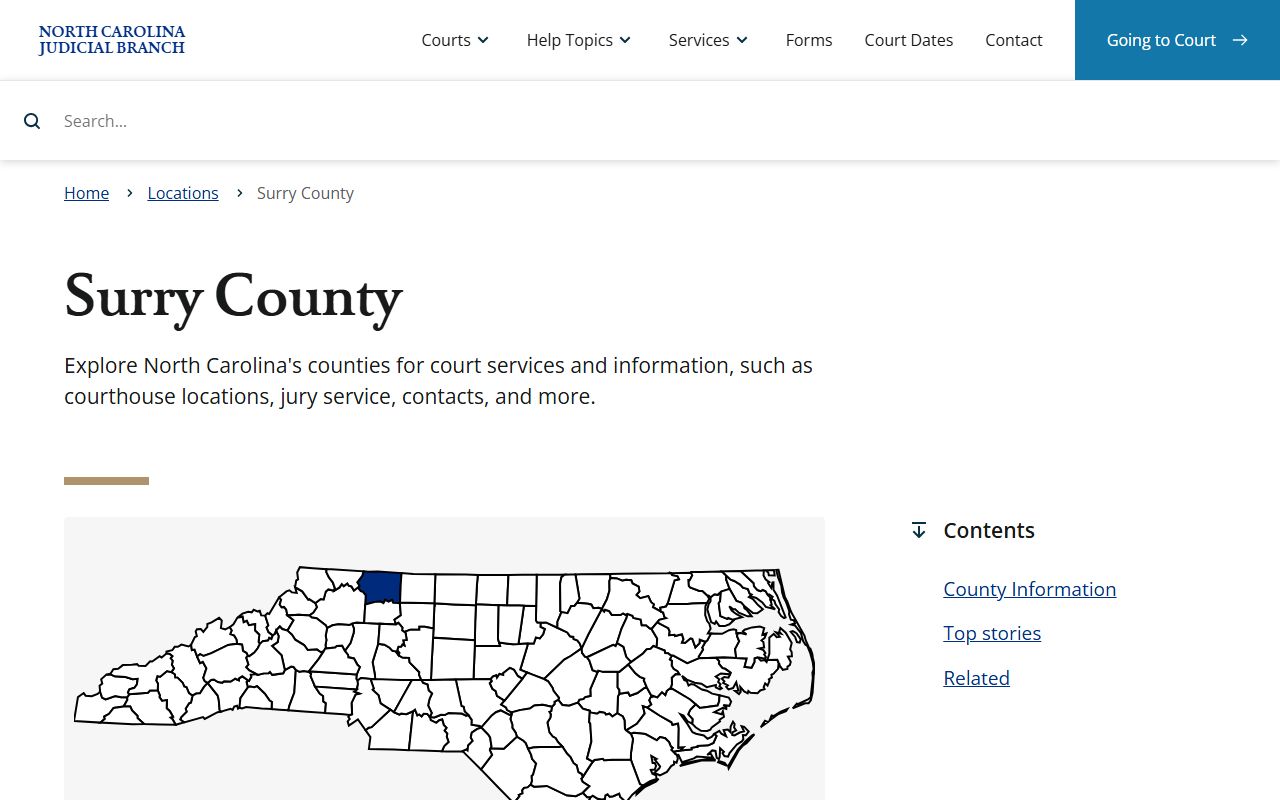
The official Surry County court page is the local entry point for Portal links and county court information.
Use the court page for judicial records and hearing data, not for jail custody or booking photos.
Surry Arrest to Court Record
The path from arrest to court record has several steps. First, the person is booked at the Surry County Detention Center. The roster may show arrest or booking charges, arresting agency, arrest date and time, bond total, and per-charge bond data. Second, a magistrate or court officer handles initial criminal paperwork and release conditions. Surry magistrate contacts are listed in Dobson at 336-386-3719 and Mount Airy at 336-789-3300. Third, the prosecutor reviews the case and decides how to proceed. Fourth, the case opens or moves through the court system, where charges may change from the booking text.
- Check the Citizen Connect custody record first when the question is whether the person is in the Surry County Detention Center.
- Use the NC Judicial Branch Portal or a courthouse terminal for the case number, filed charges, and hearing dates.
- Read each charge line separately because one booking can lead to several court counts with different statuses.
- Call the Surry Clerk of Superior Court at 336-386-3700 if online results do not answer a court-record question.
- Contact the district attorney or an attorney for prosecution or legal-strategy questions, not the jail roster.
District Attorney Tim Watson serves Prosecutorial District 23, which covers Stokes and Surry counties. The Dobson district attorney contact number is 336-386-3710, and the Danbury number is 336-593-4450. The prosecutor's role begins after arrest but remains separate from the jail. Law enforcement and jail staff may list arrest charges in Citizen Connect, while the prosecutor determines whether charges are prosecuted, amended, indicted, dismissed, or resolved by plea or trial.
Surry Charging Documents After Arrest
A charging document is the formal paper or electronic record that moves an accusation into court. North Carolina cases can involve different forms of criminal process, and the exact document depends on the charge level, case stage, and court action. A complaint or warrant may start the case. An information is usually prosecutor-filed. An indictment is tied to a grand jury and is common in more serious felony prosecution. The key point for Surry County court records after an arrest is that the court document may not match the first words shown on the jail roster.
| Document | Who Uses It | Common Role | What to Check |
|---|---|---|---|
| Complaint or warrant | Officer, magistrate, or prosecutor process | Starts or supports an initial criminal charge | Charge text, probable-cause basis, bond or order terms |
| Information | Prosecutor | States a charge the prosecutor chooses to file | Filed count, offense level, amendments, hearing schedule |
| Indictment | Grand jury and prosecutor | Formal felony charging document | Indictment language, superseding indictment, count changes |
When a Surry court file shows an indictment or superseding indictment, read the later document with care. A superseding indictment may replace or expand earlier charge language. That is one reason an old booking card can be a poor source for the current charge status. The court record is the better source for the filed case.
Surry Charge Status Records
Charge status is the current or final state of each court count. It can change during the life of the case. A Surry County jail arrest may begin with one charge phrase on the booking card, then the court record may show amended counts, reduced charges, dismissed charges, guilty pleas, or a not guilty result. The word disposition means the result or current outcome of a court charge. It should not be confused with custody status.
| Status | Plain Meaning | Why It Matters |
|---|---|---|
| Pending | The charge is open and not finally resolved. | Future court dates or orders may still be listed. |
| Amended | The charge changed from the original filing. | The court count may differ from the booking text. |
| Reduced | The charge moved to a lesser offense. | Penalties and record meaning may change. |
| Dismissed | The charge ended without a conviction. | Expunction may be worth reviewing if eligible. |
| Nolle prosequi | The prosecutor chose not to proceed on that charge. | It is a prosecution decision, not a guilty finding. |
| Guilty or not guilty | The case ended by plea, verdict, or finding. | This is the core distinction from a mere charge. |
| Failure to appear | A person missed court. | It may trigger an order for arrest. |
Bond Records After Surry Arrest
Bond information appears in two places for many Surry County cases. The Citizen Connect roster can show a bond total and per-charge bond, such as a secured bond entry, when that data has been entered for public view. The court record and bond orders explain the legal release condition. A missing bond line on the roster should not be read as permission to leave. It may mean no bond was set, the entry has not been made public, the person is held on another matter, or a separate authority has a legal hold.
| Release Term | Meaning for Surry County Cases |
|---|---|
| Written promise | The person signs a promise to appear without paying money up front. |
| Unsecured bond | A money amount is set, but payment is not required unless conditions are broken. |
| Secured bond | Cash, property, or a surety bond must be posted before release. |
| Cash bond | The full amount is paid through the proper jail or court process. |
| No bond or hold | Release is not available at that moment, or another legal hold blocks release. |
| Detainer | Another county, state, federal, probation, parole, or immigration authority has an interest. |
Confirm bond through the detention center at 336-401-8975, the courthouse, the clerk, a magistrate, or a licensed bondsman as appropriate. Money placed on an inmate trust account is not court bond. Surry County's inmate-account rules warn that money deposited into the wrong inmate account is treated as that inmate's money and is not refunded merely because the sender later needs it back.
Surry Warrants and Court Records
No complete official public Surry County active-warrant database was located in the research. The sheriff's Citizen Connect system includes Most Wanted and Arrest Search channels, but those are not a full warrant lookup. The most-wanted pages are public alert tools for selected people, not a complete court-process index. Warrant confirmation should be handled through the sheriff, magistrate, clerk, issuing court, or an attorney when safety or legal risk is present.
N.C. G.S. 15A-301 governs criminal process, including warrants and orders for arrest maintained by the clerk and directed to officers. If a warrant or order has not been served, the person will not appear as a current inmate. If it has been served, the jail roster may show the resulting booking, arresting agency, charge description, and bond or hold. A failure to appear in a Surry court case may also lead to an order for arrest.
Important: A Surry County most-wanted entry or roster card is not legal advice and is not a complete warrant confirmation.
Surry Charges Versus Convictions
A charge is an accusation. A conviction is a final result based on a guilty plea, guilty verdict, or other finding that counts as guilt. Surry County court records after a jail arrest may show charges long before any conviction exists. Treat each count with care. A person can be arrested, booked, charged, and later have a charge dismissed or changed. That is why the status and disposition lines matter more than the first roster charge text.
| Point of Comparison | Charge | Conviction |
|---|---|---|
| Stage | Accusation filed or listed in court | Final guilty result by plea or finding |
| Proof level | Based on criminal process and probable cause | Requires proof beyond a reasonable doubt or a valid plea |
| Record meaning | Shows what was alleged | Shows the offense resolved as guilt |
| Can change | May be amended, reduced, dismissed, or indicted | May be appealed, corrected, or later considered for relief if law allows |
Sealed vs Expunged Records
North Carolina uses expunction as a main path for removing eligible records from public view. N.C. G.S. 15A-146 covers expunction for certain dismissed charges and findings of not guilty or not responsible. N.C. G.S. 15A-145.5 covers expunction of certain nonviolent convictions. The NC Judicial Branch also has an expunctions help topic with court forms and procedure routing.
| Point of Comparison | Sealed | Expunged |
|---|---|---|
| Public visibility | Hidden from ordinary public access while still retained by the system. | Removed from public view under a court order if eligible. |
| Access after the order | Some agencies or courts may retain limited access under law. | Access is more restricted, but eligibility and agency-retention rules still matter. |
| Typical North Carolina route | Used when a record is restricted from public view. | Used for eligible dismissed, not-guilty, or certain conviction records. |
| Practical limit | Not every criminal justice record is sealed by a case result alone. | Some arresting-agency investigation material may be treated differently under N.C. G.S. 132-1.4. |
Expunction is not the same as a roster update. A custody card can disappear from a live jail roster because the person is released or the roster view changes, while a court record may still exist. A court-ordered expunction is the legal route for eligible public court records. Legal advice should come from a lawyer or a qualified legal-aid source.
Surry Court Record Access Limits
North Carolina public-records law is broad, but not all criminal justice material is released in the same way. N.C. G.S. 132-1 defines public records to include many papers, photographs, electronic records, and other materials made or received by public agencies. N.C. G.S. 132-6 requires inspection and copies at reasonable times unless an exception applies. Criminal investigation and intelligence records receive special treatment under N.C. G.S. 132-1.4, so some arrest reports, investigative files, and booking-related material may be limited.
Juvenile matters, sealed records, expunged records, active investigative material, and some victim-related details can be restricted. The clerk and court portal are the proper sources for public case data. The sheriff's office is the proper source for Surry County jail custody information. NCDAC records cover state prison, probation, and parole records, and NCDAC says it does not maintain county jail records.